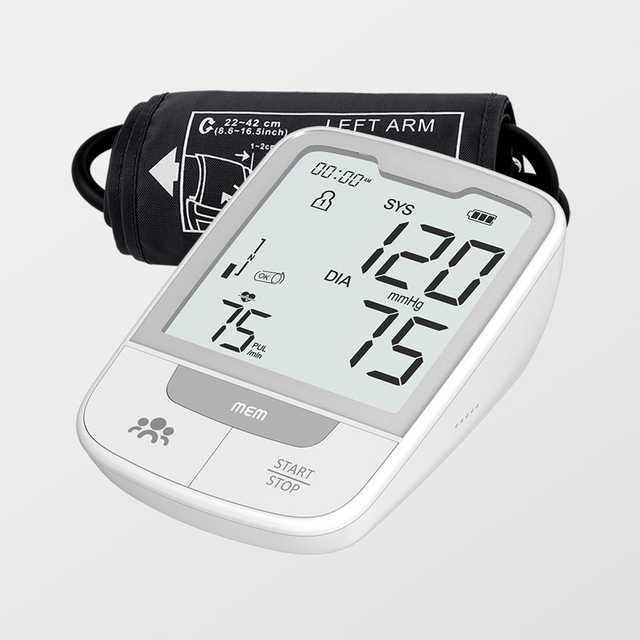
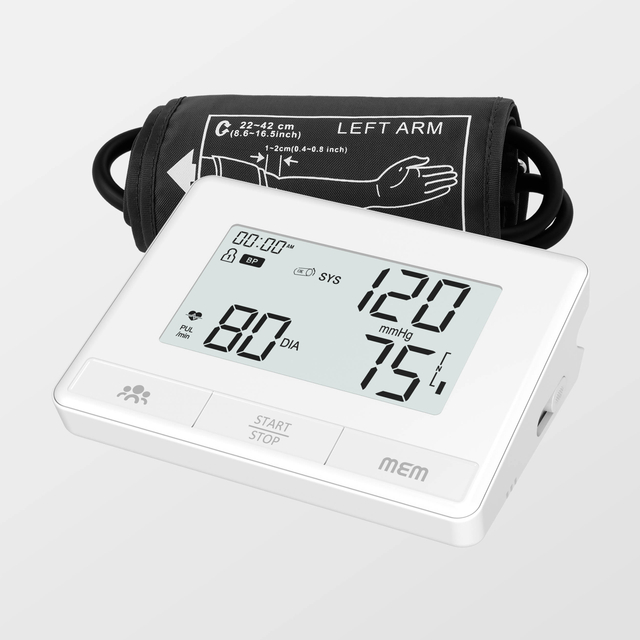
A home blood pressure monitor is one of the few medical devices in the house that never gets retired on schedule — and most of them still run on disposable cells. For a user measuring twice or three times a day, that means a pack of AA or AAA batteries quietly becomes part of the cost of managing hypertension: replaced several times a year, every year, for as long as the device lasts.
For distributors, brand owners, and private-label operators assembling a 2026–27 blood pressure program, the power architecture behind a model number has stopped being an engineering footnote. It now touches three things buyers are actively measured on: the BP monitor total cost of ownership a retail buyer can defend, the sustainability claims a listing page is allowed to make, and the battery obligations a market will apply at end of life.
What follows is a buyer's framework: where the money actually goes over the life of a unit, what rechargeable lithium and Type-C charging change in practice, how battery regulation is moving on both sides of the Atlantic, and how to map each power option to the channel that can carry it.
Why Power Architecture Became a Buying Decision, Not a Spec Line
Power source used to be a line item handed to the supplier's engineering team. It is better understood as four separate commercial exposures.
Consumable cost is now visible to the consumer. Hypertension management is a lifetime habit, not a seasonal purchase. A user who replaces batteries twice a year for a decade notices, and the retail review that follows is rarely about the cuff.
Dead-battery failures look like product failures. A monitor that will not inflate because the cells are flat generates the same return, the same complaint ticket, and the same one-star review as a monitor that is genuinely broken. Most of these units are not broken.
Sustainability claims are being audited. "Eco-friendly" on a carton is no longer a marketing adjective in the EU and in several US states; it is a substantiated environmental claim subject to consumer-protection enforcement. A rechargeable design makes the claim defensible. A disposable-powered device with green packaging does not.
End-of-life obligations are shifting onto producers. Battery extended producer responsibility (EPR), collection targets, and removability requirements are landing on the economic operator that places the product on the market — not on the consumer who throws it away.
What Disposable Batteries Actually Cost Over a Program Lifetime
Published battery life for a typical upper-arm monitor is around two months at three measurements per day. That single spec line is enough to model the consumable load:
Six replacement cycles per year. Two months per set, twelve months per year.
24 AA cells per year on a 4×AA platform; 18 AAA cells per year on a 3×AAA platform.
120 cells over five years on a 4×AA platform — against a device that may itself retail for less than the cumulative battery spend in premium retail markets.
Set that against the energy a rechargeable blood pressure monitor actually consumes. A wrist unit built around a 3.7 V / 180 mAh lithium cell stores roughly 0.67 Wh. Charged six times a year, that is about 4 Wh per year — under 0.005 kWh, before charging losses. In most markets the annual electricity cost of a rechargeable BP monitor is not a line item; it is rounding error.
What Rechargeable Changes: Lithium Cells, Type-C, and Hybrid Power
Three architectures are now in production, and they are not interchangeable.
1. Built-in rechargeable lithium with Type-C charging. A Type-C blood pressure monitor with a sealed lithium cell is the cleanest user experience and the strongest sustainability narrative: one cable, no consumables, no battery-door tooling. The design trade-off is regulatory — a non-removable cell moves the product toward battery-embedded product treatment in some jurisdictions, and it requires full lithium transport documentation (UN 38.3 test summary, IEC 62133 cell certification) for air and sea freight.
2. Removable, replaceable cell compartment. A lithium battery blood pressure monitor with a user-accessible battery door keeps the cell out of the device's waste stream and simplifies service. It also aligns with the direction EU law is taking on removability, and it lets a brand sell a replacement cell as an accessory.
3. Hybrid dual-power (AAA cells or Type-C, or an optional lithium pack). The pragmatic option for a portfolio serving several markets at once. The same validated measurement engine ships to a European retail account configured for rechargeable use and to a travel or emergency-backup channel where a fresh pack of alkalines is the whole point. Joytech's own product FAQ puts the choice where it belongs — with user habit, measurement frequency, and market expectation rather than with the factory.
Matching Power Options to the Channel: A Selection Matrix
Power architecture should be allocated the way cuff sizes are allocated — deliberately, per channel.
Channel / segment
Recommended power architecture
Why
Premium e-commerce, "modern home health" positioning
Built-in lithium + Type-C
The sustainability and convenience story is the listing narrative
Pharmacy with professional recommendation
Rechargeable, or hybrid with lithium included
Pharmacist can explain lifetime cost; documentation supports the claim
Chronic-disease / RPM programs
Rechargeable + Bluetooth
Device uptime and data continuity matter more than unit price
Tender scoring increasingly includes operating cost
Gift and senior bundles
Hybrid with voice guidance and large display
Caregiver sets it up once; charging is manageable
A distributor who serves four of these segments does not pick one architecture. They build a two- or three-tier ladder and price each rung on the value the channel actually buys.
Rechargeable and Hybrid-Power Blood Pressure Monitors at Joytech
Joytech Healthcare has manufactured clinically validated blood pressure monitors for more than two decades, shipping to over 150 countries under ISO 13485, MDSAP, and BSCI certified quality systems, with CE MDR and FDA coverage confirmed per model against destination-market requirements.
DBP-61C5 — LED-display upper-arm monitor measuring on inflation. Powered by a rechargeable lithium battery or Type-C; 2 × 60 memories (up to 2 × 150) with date and time; irregular heartbeat detection, blood pressure risk indicator, average of last 3 results; cuff 22.0–36.0 cm; optional Bluetooth and talking function.
DBP-6193 — all-in-one tubeless upper-arm monitor with integrated cuff and a 4.2-inch reversible backlit display. Power source: 3 "AAA" or Type-C or lithium battery — the dual-power choice is left to the user and the market. 2 × 150 memories, cuff 22.0–42.0 cm, approximately 123 g; optional Bluetooth, voice, and backlight. CE MDR, FDA, and additional market coverage documented per model.
DBP-62E1B — smart upper-arm monitor with Bluetooth, measure-on-inflation technology, AFib detection and MVM analysis. Power source: 4 "AAA" or Type-C; 2 × 150 memories; large cuff 22.0–42.0 cm included; optional backlight and talking function.
Across the upper-arm blood pressure monitorfamily, measurement accuracy is unaffected by power architecture — the oscillometric engine, cuff geometry, and validation data are what determine clinical performance. Power determines what the program costs to run and how it is treated at end of life.
Partner With Us
Whether your 2026–27 assortment calls for a rechargeable flagship SKU, a hybrid dual-power volume model, or a three-tier power ladder mapped to separate channels, the conversation starts with your market, your price bands, and your compliance exposure.
Joytech's OEM/ODM medical device solutions team can support battery configuration, cell certification and transport documentation, packaging claims review, and cuff-size selection. To discuss a rechargeable blood pressure monitor program for your market, contact us at sale14@sejoy.com.
FAQ
Q1: Does a rechargeable blood pressure monitor measure as accurately as a battery-powered one?
Yes. Measurement accuracy is determined by the oscillometric algorithm, pressure sensor, cuff geometry, and clinical validation — not by how the device is powered. What power architecture changes is uptime: a charged lithium cell holds its voltage under pump load far better than a partially discharged alkaline cell, so measurements late in a charge cycle behave like measurements early in one.
Q2: How long does a charge last in real home use?
Published battery life for these platforms is approximately two months at three measurements per day, 30 days per month — the same benchmark used for the disposable-cell specification. At that rate, a unit is charged roughly six times a year.
Q3: Is a built-in rechargeable battery a compliance risk in the EU?
From 18 February 2027, Article 11 of EU Regulation 2023/1542 introduces requirements for the removability and replaceability of portable batteries in products within its scope, subject to applicable derogations. Manufacturers and importers should assess the battery design against the relevant product classification, applicable exemptions, and market-entry timeline before finalizing product specifications.