Every year, the same pattern repeats across pharmacies, mother-and-baby chains, and e-commerce listings in the northern hemisphere: fever season arrives, parents reach for the fastest way to get a reliable number, and the infrared ear thermometer moves back to the top of the category. It also moves back to the top of the returns and complaint list.
What makes that second statistic commercially interesting is this: almost every ear thermometer on a sourcing shortlist claims the same laboratory accuracy — ±0.2 °C. Two units costing $12 and $28 can carry identical-looking accuracy lines on paper. The spec sheet, in other words, has stopped discriminating between them.
What still discriminates — in clinical comparisons, in consumer reviews, and in warranty return rates — is how the device behaves outside the laboratory: in a cold bedroom, on a restless toddler, in the third consecutive reading of a screening round. That is where pre-heated probe technology earns its cost. Before the probe enters the ear canal, it is warmed to near body temperature, removing the thermal gradient that quietly degrades a large share of real-world ear readings.
For distributors, brand owners, and private-label operators building a 2026–27 fever-season program, this feature deserves a defined place in the assortment rather than a bullet point on a listing. What follows is a buyer's framework: where the error actually comes from, what pre-heating changes, and how to match a pre-heated ear thermometer to the channel that can carry its price.
Why Ear Thermometer Accuracy Is a Commercial Variable, Not a Spec Line
Accuracy is usually treated as an engineering topic handed to the supplier's QA team. It is better understood as four separate commercial exposures.
A false reassurance is the most expensive outcome. When a febrile infant reads normal, the parent delays care. One such case generates more reputational damage for a brand than a hundred satisfied users generate goodwill, and in markets with medical device reporting obligations it can escalate beyond the retailer relationship.
Inconsistent repeat readings destroy category trust. A parent who takes three readings in sixty seconds and gets 36.9, 37.6, and 37.2 °C concludes that ear thermometers do not work — not that this unit does. That conclusion attaches itself to the brand on the carton, which is your carton.
Review-driven retail punishes variability. In e-commerce, the accuracy complaint is rarely the top-voted review when a product performs; it is always the top-voted review when it does not. Returns follow the same curve, and returns on a low-margin seasonal SKU can erase the season.
Accuracy is now a documented claim. Under EU MDR and the equivalent US regime, the number printed in the IFU and on the packaging must be substantiated in the technical file — by blackbody calibration data and, for ear-canal devices specifically, by clinical accuracy data. Choosing a supplier on price alone does not remove that obligation from the brand owner; it relocates it.
The practical conclusion: evaluate ear thermometers on the conditions under which the claimed accuracy holds, not on the number itself.
Where the Error Comes From: The Heat-Sink Effect and Four Other Variables
An infrared ear thermometer does not measure temperature directly. It measures the thermal radiation arriving at a thermopile from the tympanic membrane and surrounding canal tissue, and converts it — using the detector's own reference temperature as part of the calculation — into a displayed value. That architecture is sensitive to several things, and only the last one is operator error.
1. The Heat-Sink Effect (Thermal Gradient)
This is the dominant one, and the reason pre-heating exists. A probe stored at typical room temperature — say 20 °C — is roughly 17 °C colder than the ear canal it enters. Contact with canal tissue draws heat out of that tissue locally, cooling the surface the sensor is looking at. The device then reads the measurement site it has itself altered.
The magnitude is not uniform. It is worst in precisely the conditions that define fever season: a device kept in an unheated bedroom overnight, a clinic carrying units between rooms, an ambulance bag in a winter vehicle, a user who measures immediately after picking the unit up. It is also worse in a narrow pediatric canal, where tissue mass is small and cools faster.
2. Detector Reference Stabilization
Because the thermopile output depends partly on the detector's own temperature, the internal reference needs to be thermally settled before the reading is trustworthy. Pre-heating stabilizes it. This is why units that have just been switched on often drift across the first few measurements.
3. Ambient Operating Limits
ASTM E1965-98 requires an ear canal infrared thermometer to meet its laboratory error limits across an operating range of 16–40 °C — and requires the device to carry a cautionary label if its range is narrower. Anything below the manufacturer's stated floor is outside spec by definition, and no amount of software compensation makes it otherwise.
4. Probe Placement and Canal Anatomy
Correct placement requires straightening the pinna so the probe has a clear sight line to the tympanic membrane. In infants the maneuver is harder, the canal curves more sharply, and the operator is often doing it one-handed by nightlight. Cerumen and recent ear surgery further change what the sensor sees.
5. Probe Cover Consistency
Under ASTM E1965-98, an ear canal thermometer using a probe cover must maintain its declared laboratory error with the cover in place. A disposable cover sits directly in the optical path; inconsistent thickness or material changes infrared transmittance. This is a real and frequently overlooked source of error in low-cost assembly, and it is also why a probe cover should be specified as part of the measurement system — not bought separately from the cheapest available source.
Of these five, only placement is fully within the user's control. Pre-heating addresses the first two directly and reduces their interaction with the third.
What Pre-Heated Probe Technology Actually Changes
A pre-heated probe warms the sensing head to near body temperature before it enters the ear canal — implementations typically target around 30–37 °C. On Joytech's DET-1215, that translates into a 6–10 second pre-heat followed by a 3-second reading, across a measurement range of 32.0–43.0 °C.
Three mechanisms are at work, and they are worth separating because they produce different benefits:
The canal is not cooled. With the probe already close to tissue temperature on contact, there is no meaningful heat transfer away from the measurement site. The sensor reads the canal as it actually is.
The internal reference is stable. Readings taken after pre-heating do not drift between consecutive measurements, so the second and third readings agree with the first — which is what users actually judge a device by.
Contact is maintained. A warm probe does not provoke the flinch reflex that pulls a cold probe out of position mid-measurement. In infants, this directly affects the quality of placement, and therefore accuracy.
Matching Pre-Heated Ear Thermometers to the Right Channel
Pre-heating does not belong everywhere. It belongs where accuracy is the purchase reason.
Channel / Segment
Recommended approach
Pharmacy, professional recommendation
Pre-heated. The pharmacist's recommendation is the value proposition; documentation supports it.
Mother-and-baby retail
Pre-heated as the premium hero SKU, one-second non-preheated as the volume SKU below it.
Premium e-commerce
Pre-heated, with accuracy and comfort as the listing narrative rather than price.
Entry-level e-commerce, price-led
Non-preheated one-second unit; pre-heating is invisible in a price-war listing.
Clinic, hospital supply, tenders
Pre-heated where repeatability across multiple patients is specified.
Occupational / high-throughput screening
Non-preheated; cycle time outweighs the gradient benefit.
Connected health bundles
Pre-heated with Bluetooth, paired to the app ecosystem.
A distributor serving several of these segments does not choose one device. They map each SKU to a channel deliberately, with claims language matched to each market's classification.
Ear Thermometer OEM/ODM Programs at Joytech
Joytech Healthcare has manufactured clinical and home-use thermometry for more than two decades, shipping to over 150 countries, and operates ISO 13485, MDSAP, and BSCI certified quality systems.
Pre-heated infrared ear thermometers
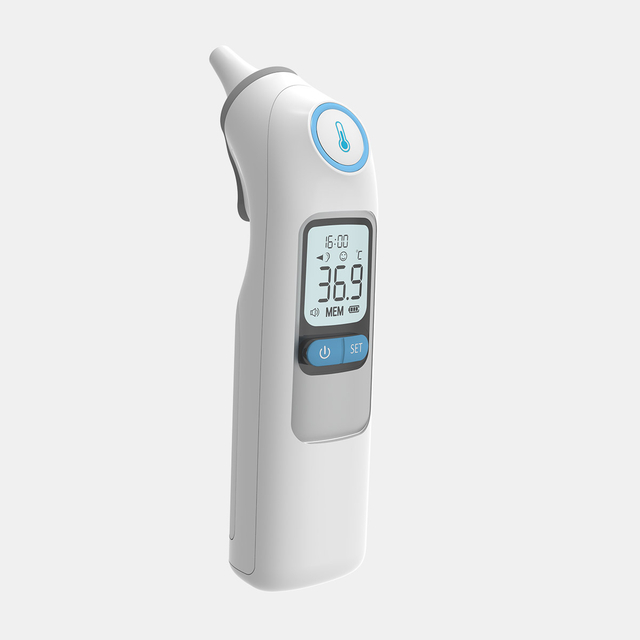
DET-1215 — All-Ages Clinical Infrared Thermometer with Backlight & Memory Recall. Pre-heated probe delivering a 3-second reading after a 6–10 second pre-heat; declared accuracy ± 0.2 °C across 35.5–42.0 °C over a 32.0–43.0 °C range; 30 memories with dual °C/°F; object mode; fever alarm at ≥ 37.8 °C; probe cover recognized and required for measurement. Powered by a 3 V / 1,900 mAh rechargeable lithium cell with an optional storage-type charging dock, specified at approximately 1,000 readings. Optional Bluetooth, three-colour backlight, mute, and age classification; unit weight approximately 107 g. CE MDR and FDA 510(k) coverage confirmed per model against destination-market requirements.
The optional age classification is worth flagging in an RFQ context: it is the user-facing counterpart of the per-age-group clinical validation ASTM E1965-98 requires, so models that offer it generally sit on top of a documented age-segregated dataset rather than a single pooled one.
Partner With Us
Whether your fever-season program calls for a pre-heated flagship SKU or a two-tier ear thermometer ladder, the conversation starts with a clear picture of your channel, price band, and target markets. Joytech works with distributors, brand owners, and private-label operators to confirm certification coverage, align specifications, and scope documentation against launch windows.
To discuss an ear thermometer OEM/ODM program, request category documentation, or arrange technical evaluation samples, contact sale14@sejoy.com.